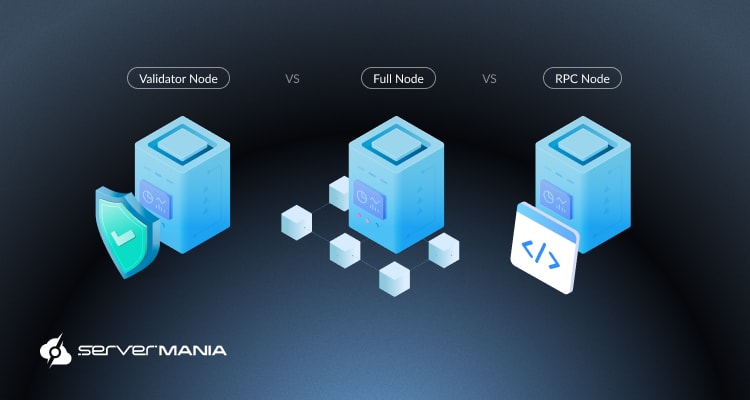
Comparing validator nodes against full nodes and RPC nodes really matters when the business or project needs reliable infrastructure for participating in a blockchain network.
This guide is for node operators, developers, and organizations deciding between a validator, full node, or RPC node and looking to understand the hardware, connectivity, security, and hosting requirements.
ServerMania understands the need for reliable blockchain infrastructure. We provide dedicated servers through Blockchain Server Hosting for projects needing high-performance blockchain node deployment. With dedicated hardware, flexible configurations, and strong network infrastructure, ServerMania helps you deploy and maintain nodes without managing the physical infrastructure yourself.
Here we’ll go over the differences between validator, full, and RPC nodes, their hosting requirements, and the importances to consider before choosing your infrastructure.
What Is a Blockchain Node?
A blockchain node is just a server running software that communicates with the blockchain network and helps with various operations like verification, serving, and maintenance. There are different types of nodes, some of which validate transactions, others simply store blockchain history or participate in the consensus mechanism, providing data to real-time applications.
The actual role of a blockchain node is what determines the type of hosting infrastructure it requires to run sufficiently. This means CPU, RAM, storage space, network bandwidth, connectivity, and uptime, all of which directly affect how a node would perform.
See Also: What is Blockchain Technology
📖 Blockchain Technology Terminology
Before we continue, let’s make sure that we fully understand the terminology, which will make it much easier to grasp the concepts and compare node types:
| Term: | Definition: |
|---|---|
| Blockchain | A distributed digital ledger where transactions are recorded in linked blocks. |
| Node | A machine running special software that processes, verifies, or stores data. |
| Consensus | The process that all nodes use to agree on the valid state of the blockchain. |
| RPC | Remote Procedure Call (RPC) is a protocol allowing apps to request actions. |
The three main types covered in this guide are:
- Validator: A validator node participates directly in the consensus process, responsible for all the validation duties, based on the protocol (proposing or voting).
- Full Node: A full node refers to a machine that verifies a complete copy of the required data in the blockchain network without consensus participation.
- RPC Node: RPC nodes provide an RPC endpoint that applications, wallets, and analytics platforms use to query blockchain data and submit requests.
Note: The different types of nodes help maintain the decentralization of blockchain networks.

Validator Node vs Full Node vs RPC Node
While all three node types communicate with the same blockchain network, they are designed to serve very distinct purposes. For instance, a validator node focuses on the consensus mechanism, while full nodes prioritize independent verification and storage. In turn, the RPC node serves data to applications running in real time through an RPC endpoint. Let’s learn more…
See Also: Blockchain Layers: Layer 1 vs Layer 2
Validator
The validator node is an active participant in the network’s core consensus process. The most common responsibilities of a validator node include validating transactions, processing new blocks, voting on proposed blocks, and proposing blocks (based on the protocol).
Validators require consistent performance because their duties often operate continuously. A temporary outage, high latency, or synchronization problem might prevent a validator from performing its assigned duties. In many cases, you’ll find networks that impose penalties for nodes that occasionally go offline.
This makes infrastructure considerations critical.
Note: Validators are selected to propose blocks based on the network’s consensus rules, which might consider stake, randomization, or other factors. A block reaches finality when enough validators attest to or otherwise confirm it according to the protocol’s consensus rules.
Full Node
A full node independently verifies blockchain activity and does not participate directly in the consensus, unlike the validator node. Instead, a full node downloads blocks of data and transactions, checks them against the rules of the established protocol, and then maintains the state required by the configuration.
This makes full nodes useful for businesses and developers who need access to fully verified blockchain data. Running your own full node removes dependence on third-party data providers and gives you full control over how your infrastructure connects to the network.
Note: Some networks require substantial cryptocurrency staked as collateral to operate a validator. The required stake varies by blockchain and represents a significant financial commitment, as validators might also face penalties for certain protocol violations or downtime.
RPC Node
An RPC node serves blockchain data and functionality to external applications. So, instead of interacting with the node through its local command line, applications send requests to an RPC endpoint to retrieve balances, query blocks, submit transactions, or interact with smart contracts.
RPC workloads differ from standard node operation because the server needs to process requests from apps while maintaining its underlying blockchain services. So, a high-traffic RPC deployment will place greater emphasis on CPU capacity, RAM, storage, network throughput, request handling, and availability.
To be able to explore the nodes side-by-side, here’s a full comparison:
| Validator Node | Full Node | RPC Node | |
|---|---|---|---|
| Purpose | Validation of Blockchain Data | Verification and Maintenance | Serve Blockchain Data to Apps |
| Consensus | Participation | No Participation | No Participation |
| Workload | Validation and Consensus | Verification and Synchronization | API and RPC Requests |
| CPU Demand | High | Moderate to High | Moderate to High |
| RAM Demand | Moderate to High | Moderate to High | Moderate to High |
| NVMe Storage | Recommended | Required | Required |
| Lag Sensitivity | High | Moderate | High |
| Uptime | 99,99% | 99,99% to 100% | 99,99% to 100% |
| Public Access | Usually Restricted | Usually Restricted | Externally Accessible |
| Security Priority | High | High | High |
Penalties like slashing can result from dishonest behavior or frequent downtime of validators. They are crucial for preventing fraudulent activities in blockchain. What’s interesting is that validator nodes earn cryptocurrency rewards for validating transactions. These rewards encourage validators to participate reliably and honestly in the network.
Note: When choosing a provider for validator infrastructure, it’s crucial to ensure high uptime. Most professional hosting offers ensures 99.99% uptime for validator nodes.
Blockchain Node Hosting Infrastructure Requirements:
The infrastructure required for a blockchain node depends on its role and workload. Validators prioritize consistent performance and connectivity; full nodes place greater demands on synchronization, while RPC nodes need enough compute and network capacity to handle application requests simultaneously.
See Also: Blockchain Types and What They Are Used For?
To understand the infrastructure requirements, let’s go through them:
🔵Validator Infrastructure Requirements:
Now that we know the purpose of a validator, understanding its performance requirements will surely allow us to narrow down the ideal infrastructure. A validator needs consistent processing performance because it continuously performs consensus-related tasks.
CPU performance and RAM keep transaction validation and consensus operations responsive, while fast NVMe storage helps the node process blockchain databases and remain synchronized.
The network reliability is equally important. A validator needs a reliable internet connection, low latency, sufficient network bandwidth, and minimal packet loss to communicate with peers without interruptions. High availability also reduces the risk of missed validation duties.
Here’s an example:
| Infrastructure: | Recommended: |
|---|---|
| CPU | 8+ physical cores |
| RAM | 32 GB+ |
| Storage | 1 TB+ NVMe SSD |
| Network | 1 Gbps+ |
| Connection | Low latency, stable routing |
| Availability | 99.9%+ |
| Security | Firewall, Restricted Ports, DDoS Protection |
The infrastructure examples below are surface-level guidelines. Actual requirements vary by blockchain. For example, most Solana nodes, specifically Solana validator nodes, require at least 384 GB of DDR5 ECC RAM, along with substantially higher compute and storage resources.
🔵Full Node Infrastructure Requirements:
A full node will place much more demand on storage because these types of nodes constantly retain and verify blockchain data. The storage speed here plays a vital role in sync time, so it’s recommended to use fast NVMe SSDs for maximum storage performance.
Network infrastructure also needs to support continuous data exchange with peers. A full node requires a stable internet connection, sufficient bandwidth, and enough capacity to download new blocks and remain fully synced as the blockchain grows. Here’s an example:
See Also: What is NVMe SSD and NVMe vs SATA
| Infrastructure: | Recommended: |
|---|---|
| CPU | 8+ physical cores |
| RAM | 32 GB+ |
| Storage | 1 TB+ NVMe SSD |
| Network | 1 Gbps+ |
| Storage priority | Capacity and sustained I/O |
| Availability | 99.9%+ |
| Security | Firewall and restricted services |
These requirements are just a starting point for node operators running a full node on their own node infrastructure. An archive node requires substantially more storage, while powerful hardware and fast storage help reduce CPU usage and synchronization time as the blockchain grows.
🔵RPC Node Infrastructure Requirements:
RPC nodes need hardware optimized for both blockchain processing and application requests. Strong CPU performance and sufficient RAM help handle concurrent requests, while fast NVMe storage reduces database response times when applications request blockchain data.
Here, network capacity becomes especially important as request volume increases. An RPC deployment needs high bandwidth, low latency, reliable routing, and traffic controls to prevent excessive requests from affecting node performance. Here’s an example:
| Infrastructure: | Recommended: |
|---|---|
| CPU | 8 to 16+ physical cores |
| RAM | 64 GB+ |
| Storage | 1 TB+ NVMe SSD |
| Network | 1 to 10 Gbps+ |
| Connection | Low Latency & High Availability |
| Access | Controlled |
| Security | Authentication, Rate Limiting, DDoS Protection |
RPC workloads vary depending on application traffic, request volume, and the number of users that are accessing public endpoints. So, for production deployments, dedicated hardware, a high-performance network connection, and strong network security help maintain the service and protect the RPC node.
Dedicated Server vs Cloud Hosting for Blockchain Nodes
Choosing between a dedicated server and cloud hosting depends on the node’s workload, performance requirements, and expected growth. While dedicated servers provide physical resources and predictable performance, cloud platforms offer flexible provisioning and easier scaling across different infrastructure.
Dedicated Servers for Node Hosting
A dedicated server offers exclusive access to hardware resources like CPU, RAM, storage, and network, which makes it an ideal environment for hosting blockchain nodes. A dedicated infrastructure also gives operators greater control over the underlying environment.
You select the hardware configuration, operating system, storage, and network setup without sharing physical resources with other workloads. For demanding blockchain deployments, this approach avoids the variable performance associated with shared infrastructure.
Cloud Platforms for Node Hosting
Cloud hosting provides access to virtualized infrastructure that you provision according to your current requirements. It works well for development environments, temporary nodes, testing, and workloads where resource requirements change frequently. The main benefit is flexibility.
You can adjust resources or deploy a new node without purchasing or configuring physical hardware. Cloud infrastructure also makes it easier to distribute the workloads across regions, although resource pricing and performance depend on the provider and selected instance.
The Cost of Running a Blockchain Node?
Running a blockchain node involves both upfront hardware costs and ongoing infrastructure expenses. For instance, initial setup costs can range from$15,000 to $50,000, depending on the node type, hardware configuration, storage capacity, network requirements, and redundancy.
A typical validator node setup costs between $15,000 and $50,000, with the final investment influenced by the blockchain protocol and required infrastructure. On top of that, we should not forget about annual operational expenses can exceed $60,000. In addition, electricity costs are very significant for running a validator node, so you should evaluate this as well.
Note: These figures represent enterprise-grade blockchain node deployments with high-performance hardware. Smaller setups, development nodes, and single-server deployments require a much lower initial investment and have significantly lower ongoing costs.
ServerMania Hosting for Blockchain Nodes

ServerMania provides dedicated servers with fully customizable configurations designed to match your blockchain node ideally. Choose the CPU, RAM, storage, and other resources your deployment requires, with fast NVMe storage and network connectivity of up to 4 x 25 Gbps.
Our data centers across Canada, North America, and Europe give you flexibility when choosing where to host your node. Paired with 24/7 human support for infrastructure issues and full transparency without hidden transaction fees, you’re guaranteed reliable deployment.
💬Ready to run your blockchain node on dedicated infrastructure? Explore Blockchain Server Hosting from ServerMania or book a free consultation. We’re available right now!
Frequently Asked Questions:
What hardware is required for running a validator node?
The hardware requirements for validator node running depend on the blockchain, but production nodes typically need strong processing power, fast storage, sufficient RAM, and reliable connectivity. Always check the network’s documentation for specific hardware and software requirements.
How does a validator node maintain blockchain integrity?
A validator node operates by verifying transactions and participating in consensus, helping maintain blockchain integrity. Proper network addresses, communication ports, and a high-speed internet connection also support reliable communication with other nodes.
Is bare metal better than public nodes?
Running your own node on bare metal provides greater control over ledger data and resources than relying on public nodes. It also involves a significant hardware investment, so consider your workload and operational costs before choosing bare metal.
What software is required to run a blockchain node?
The software requirements depend on the blockchain, with operators often using command-line tools in a terminal window to install and configure the node. Documentation typically provides commands such as sudo mkdir and the following command needed for installation.
How do you secure a validator node?
Protect the validator’s key pair, restrict unnecessary communication ports, and secure access to the server. This becomes especially important when the validator controls staked funds or participates in governance decisions.
💬Learn more about Blockchain Technology in our Knowledge Base.
Was this page helpful?
About the author