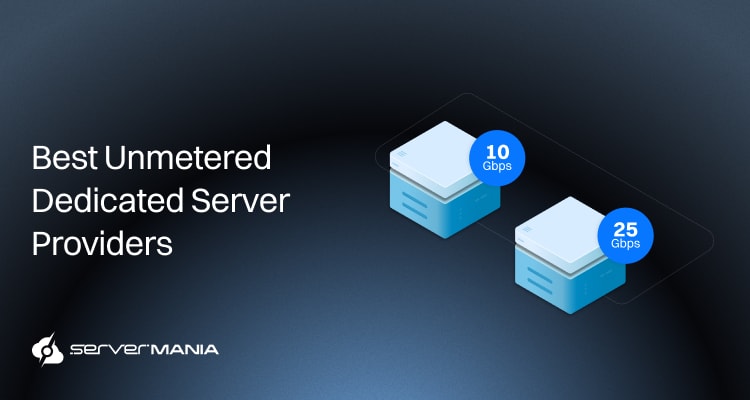
Choosing the best unmetered dedicated server is much more than comparing the monthly cost and the advertised port speed. The actual performance depends on several factors, like infrastructure, quality of routing, deployment speed, and whether the provider can handle sustained high bandwidth consumption.
This guide compares the best unmetered dedicated server hosting providers, based on thorough criteria, including port speed, real throughput, deployment time, network footprint, pricing clarity, and support.
What Unmetered Really Means?
When exploring hosting providers and their offers, you’ll often meet terms like “unlimited bandwidth” or “unmetered traffic“, but those terms do not always mean the same thing. It’s crucial to understand how bandwidth restrictions and billing work before choosing a hosting provider, so you can avoid surprises.
What unmetered really means is that the provider will not charge you based on the amount of transferred data. Instead, the connection speed becomes the only limitation. For instance, the server receives a fixed port speed, like 10Gbps or 20Gbps, and the customer is free to use the connection continuously without bandwidth charges. Of course, this doesn’t mean “unlimited” as many providers disclose a “fair usage” limit, which allows them to investigate excessive abuse or patterns that impact the entire infrastructure.
See Also: Metered vs. Unmetered vs Unlimited Bandwidth Dedicated Servers
Metered Vs. Unmetered Server Hosting
With that being said, we can compare metered vs unmetered:
- Metered hosting charges customers based on the bandwidth usage, with allocated monthly transfer quotas like 20TB or 100TB.
- Unmetered hosting removes transfer caps, and instead of counting transferred data, providers limit throughput through port speed.
Unmetered connections are suitable for businesses that require continuous heavy data flows, such as media streaming, gaming servers, and VPN services. Unmetered dedicated servers are well-suited for high-traffic eCommerce websites, as they can absorb traffic spikes during peak shopping periods without degrading performance or incurring additional costs. Hence, true unmetered plans should have 100% cost predictability with no surge charges or ‘burstable’ fees.
Interesting Fact: A 1Gbps unmetered port can move approximately 330TB of data in a month if maxed out constantly.
How We Evaluated the Unmetered Dedicated Providers
To be able to rank the best unmetered dedicated server hosting providers accurately, our priority was to consider factors that have the biggest impact. Those include the bandwidth performance, infrastructure reliability, long-term value, limitations, and clarity.
The list below is ordered by importance, starting with the factors that matter most for high-bandwidth workloads and enterprise deployments.
Port Speed & Throughput
The first and most important thing with unmetered dedicated providers is whether they advertise port speed or sell network capacity. We evaluated whether providers consistently deliver stable throughput under continuous load, including during peak traffic hours.
In addition, we’ve taken a look at the ease of customization when it comes to network speed, peering, congestion, failover response, and more.
Networking & Connectivity
The next critical factor for unmetered dedicated servers is latency, routing, and redundancy. We have evaluated the network presence, data centers, and carrier diversity to determine how well each of the providers can handle diverse traffic across different markets.
Deployment & Scalability
Deployment and scalability are just as important because it matters for enterprises and how quickly they can scale operations and infrastructure. We’ve evaluated deployment speed by checking out hardware availability, upgrade flexibility, custom configurations, and provisioning.
Price Transparency & Clarity
When it comes to “unmetered,” there is a lot of misleading advertising. Many hosting providers hide fair usage policies, additional setup fees, or hidden bandwidth limitations. That’s why we prioritized providers with clear and transparent pricing structures, predictable monthly costs, and clearly set usage policies.
Technical Support Quality
Last but not least, we’ve carefully evaluated the availability and responsiveness of the technical support, which plays a vital role in troubleshooting, setup, and deployment. High-bandwidth infrastructure needs experienced support teams, with an on-site, hands-on approach to big workloads and complex setups.
Now that we know our criteria, let’s move on to the best unmetered dedicated server hosting providers.
Top 5 Unmetered Dedicated Servers Hosting Providers
1. ServerMania

ServerMania offers unmetered dedicated servers alongside colocation infrastructure, backed by a fully-fledged cloud platform (AraCloud). The advanced ecosystem focuses on hardware flexibility, data center diversity, SLA guarantees, and a high level of compliance.
From a network perspective, ServerMania stands out with unmetered port options reaching up to 4 x 25 Gbps, without overage billing. Data centers span multiple locations across Canada, North America, and Europe, including New York, Los Angeles, London, Montreal, Vancouver, Amsterdam, and Buffalo. The entire infrastructure is backed by 24/7 free customer support and consultations, featuring a high level of server customization, availabiltiy and flexible network options.
| Strengths: | Limitations: |
|---|---|
| Up to 4x 25Gbps unmetered dedicated server connectivity. | Custom hardware deployments may require additional provisioning time. |
| Strong hardware customization, flexibility, and availability. | Enterprise-focused customization may feel excessive for smaller projects. |
| Global Network Reach (Canada, Europe, and North America), | |
| Transparent and fixed bandwidth pricing without overage billing. | |
| 24/7 personalized technical support and free consultations. |
Best For:
- High-throughput, demanding enterprise infrastructure
- Bandwidth-heavy CDN, content distribution workloads
- AI, Machine Learning, and data-intensive applications
- Businesses requiring extensive hardware customization
- Enterprises needing responsive infrastructure support
ServerMania works particularly well for businesses that prioritize network stability, hardware flexibility, responsive technical support, and scalability. While ServerMania offers solutions for small businesses through instant dedicated servers, the main trade-off comes from the enterprise-oriented approach, since highly customized deployments require commitment.
Note: ServerMania’s most popular Tier-1 Amsterdam datacenter facility, close to the AMS-IX internet exchange, adheres to European regulations, including GDPR.
2. OVHcloud

OVHcloud offers a broad range of infrastructure options that include unmetered dedicated servers, VPS hosting, storage solutions, and network services. Their primary focus lies in infrastructure segmentation with dedicated server families tailored for specific cases, while keeping the level of customization high.
From a networking perspective, OVHcloud is a bandwidth-focused provider. They provide guaranteed public bandwidth up to 25Gbps alongside data center infrastructure spanning multiple locations across Europe, North America, and Asia-Pacific. The pricing structure is transparent with predictible monthly billing, and no overage fees on the unmetered options.
| Strengths: | Limitations: |
|---|---|
| Guaranteed public bandwidth options up to 25Gbps. | The public bandwidth options vary based on the underlying configuration. |
| Large global network footprint across three continents. | Some server configurations are only available in specific data center regions. |
| Transparent pricing with many unmetered traffic options. | |
| Free customer support with a rich resource knowledge base. | |
| Wide range of use case-specific dedicated server solutions. |
Best For:
- Large-scale bandwidth-heavy hosting environments
- Teams that prefer simplicity through network solutions
- Organizations that handle media distribution platforms
- Enterprise virtualization clusters & connectivity options
- Businesses that require broad geographic coverage
OVHcloud performs exceptionally well for organizations prioritizing raw network capacity, geographic reach, and pricing predictability. The trade-off comes from its scale. While the infrastructure is extensive and technically mature, smaller businesses may find the support experience less hands-on compared to more specialized infrastructure providers. So, for bandwidth-heavy workloads operating across multiple regions, OVHcloud remains one of the strongest dedicated server platforms available.
3. Leaseweb

Leaseweb provides unmetered dedicated servers, cloud, colocation, and hybrid options, making it one of the more network-oriented providers in the hosting space. The company keeps a large server inventory, with highly customizable server configurations, including hardware, connectivity, software, and services.
From a networking point of view, the best advantage comes from its European presence, particularly in Amsterdam. Their infrastructure supports unmetered connectivity options up to 25Gbps, plus flexible 95th percentile bandwidth billing models. Leaseweb operates facilities across Europe, North America, Asia, and Australia, though Europe remains the core of its infrastructure footprint.
| Strengths: | Limitations: |
|---|---|
| Strong Amsterdam network presence with broad European connectivity. | Base-tier support, while priority support tiers require additional cost. |
| Flexible bandwidth billing options and auto Uplink port speed setup. | Some advanced networking configurations require manual planning. |
| Quick dedicated server provisioning and deployment. | |
| Flexible networking and private interconnect options. | |
| A combination of pre-made and highly customizable unmeted server options. |
Best For:
- High-throughput enterprise infrastructure handling heavy workloads
- Streaming and large-scale content distribution network deployments
- AI, machine learning, and other compute or data-intensive applications
- Businesses requiring extensive server hardware and network flexibility
- Enterprises that prioritize responsive technical support and scalability
Leaseweb performs particularly well for businesses that prioritize network flexibility, scalable bandwidth options, and strong European routing performance. The main trade-off comes from its support structure, since premium support responsiveness is tied to higher service tiers. For technically experienced teams that value bandwidth tailoring and fast deployment, Leaseweb remains a stronger network-oriented dedicated server provider on the market.
4. Serverroom

ServerRoom is a dedicated server hosting provider focused heavily on streaming, IPTV delivery, audio broadcasting, and other bandwidth-intensive workloads. Unlike general-purpose hosting companies, ServerRoom positions its unmetered dedicated server lineup specifically around continuous media delivery and high-volume data transfer applications.
From a networking standpoint, ServerRoom is one of the more aggressive providers in this comparison regarding raw port speed availability. The company provides dedicated unmetered port options scaling from 1Gbps up to 100Gbps. Facilities are available across New York, Miami, San Francisco, Amsterdam, and Bucharest, helping improve low-latency access for international audiences.
| Strengths: | Limitations: |
|---|---|
| Dedicated server unmetered port options reaching up to 100Gbps. | Smaller global reach than larger enterprise hosting providers. |
| Strong focus on CDN, streaming, and IPTV network traffic optimization. | More specialized toward media workloads than general enterprise hosting. |
| Transparent fixed pricing without transfer-based billing. | |
| High-performance hardware configuration options with high availability. | |
| Low-latency routing is made for continuous media delivery. |
Best For:
- IPTV, streaming, and media delivery platforms with high traffic demands
- CDN edge nodes environments that require a predictable network speed
- Audio streaming, podcasting, and internet radio infrastructure deployments
- Businesses requiring ultra-high port capacity with fixed monthly pricing
- Applications sensitive to latency, buffering, or inconsistent network reliability
ServerRoom performs exceptionally well for businesses prioritizing predictable, unmetered bandwidth pricing, large-scale streaming delivery, and continuous high-throughput workloads. The biggest trade-off comes from specialization. While the provider shines with a streaming-oriented server, organizations seeking broader ecosystems or highly diversified services may prefer larger multi-service platforms.
5. OneProvider

OneProvider functions as a globally distributed infrastructure marketplace, offering unmetered dedicated server options. OneProvider’s advantage comes from the aggregation and the geographic reach across North America, Europe, Asia, Oceania, South America, and Africa.
The provider offers multiple unmetered dedicated servers and high-bandwidth deployments, including dedicated unmetered port configurations with both 1Gbps and 10Gbps options in selected facilities. However, unlike some enterprise-focused competitors, many of its unmetered servers operate under Fair Usage policies. This means the provider may investigate or throttle speeds during sustained periods of excessive network traffic or unusually high bandwidth consumption.
| Strengths: | Limitations: |
|---|---|
| Massive worldwide data center coverage across 140+ locations. | Fair Usage policies apply to unmetered bandwidth plans. |
| Flexible regional deployment for localized network connectivity. | Sustained full-port utilization may trigger a traffic investigation. |
| Wide range of dedicated server options and bandwidth configurations. | Less focused on guaranteed enterprise-grade throughput. |
| Competitive pricing for globally distributed infrastructure. | |
| Strong option for reducing latency in regional markets. |
Best For:
- Businesses deploying high-traffic sites close to international user bases
- Teams that require a globally distributed dedicated hosting infrastructure
- Caching and file hosting deployments across multiple worldwide regions
- Teams prioritizing regional low latency and localized network optimization
- Developers needing flexible worldwide hosting solution deployment options
OneProvider fits businesses prioritizing worldwide deployment flexibility and network infrastructure that provides coverage with guaranteed unrestricted throughput. The biggest trade-off comes from the Fair Usage model used on many unmetered dedicated server offerings, since unmetered bandwidth means traffic is not billed per TB, but it does not always guarantee ongoing utilization at maximum port speed.
Other Honorable Mentions: Liquid Web, Hivelocity, Hetzner, Psychz Networks, ReliableSite, and GTHost.
Unmetered Dedicated Server Providers Comparison
After our evaluation, it’s clear that now all unmetered dedicated server providers offer the same level of network reliability, throughput, and consistency. They use different pricing models, architecture, server configuration approach, and deployment, where “unmetered bandwidth” could mean different network capacity, routing quality, and hidden traffic limits.
To put things into perspective, we’ve prepared an easy-to-scan table to help you spot these differences and help you choose a provider that makes sense to you.
| ServerMania | OVHcloud | Leaseweb | OneProvider | ServerRoom | |
|---|---|---|---|---|---|
| Port Speed | Up to 4 x 25Gbps | Up to 25Gbps | Up to 10Gbps+ | 1Gbps to 10Gbps | Up to 100Gbps |
| Throughput | High | High | Moderate | Moderate | Moderate |
| Deployment | Instant or Custom | Instant | Instant | Fast | Fast |
| Data CentersLocations | Canada, North America, Europe | Europe, North America, Asia-Pacific | Europe, North America, Asia, Australia | Worldwide(140+ data centers) | US + Europe |
| Pricing | Transparent and fixed | Transparent and fixed | Transparent and flexible | Transparent and fixed | Transparent and fixed |
| Support | Personalized 24/7 | Enterprise support | Tiered support | Varies by facility | Specialized support |
| Bandwidth | True unmetered | True unmetered | Mixed | Fair Usage | True unmetered |
| Predicibility | Excellent | Excellent | Moderate | Moderate | Excellent |
As the table illustrates, the best unmetered dedicated server provider depends on the requirements of the workflow, expected monthly traffic, and network connectivity needs. Some providers focus on raw high throughput and optimization, while others prioritize data center reach, enterprise scalability, or flexible hardware specifications. Let’s move on and learn how you can evaluate providers by yourself.
See Also: Top 8 Use Cases for 100 Gbps Unmetered Dedicated Servers
What to Look for in Unmetered Dedicated Hosting Providers?
Unmetered dedicated server plans are designed for businesses with bandwidth-intensive workloads, handling large amounts of network traffic.
While many providers advertise unlimited traffic and high network speed, the long-term performance depends on the quality of the underlying physical resources, routing infrastructure, and the ability to maintain stable throughput during peak demand.
Here’s everything you need to evaluate when choosing an unmetered hosting provider:
- Dedicated Port Capacity: You must verify whether the provider offers a true dedicated, unmetered port with guaranteed fixed speed connectivity.
- Bandwidth Usage Policies: Thoroughly investigate whether the provider applies any hidden traffic limits, shared with concurrent users, and potential throttles speeds.
- Network Infrastructure: Review the provider’s peering relationships and proximity to the internet exchanges for a lag-free environment.
- Hardware Specifications: Aside from the networking, the underlying hardware matters, so verify high-speed RAM, SSD storage, or NVMe storage, and evaluate hardware bottlenecks.
- Support & Management: Explore available server management options, technical support quality, and deployment flexibility.
- Long-Term Pricing Stability: Compare monthly pricing carefully, since some providers introduce hidden fees, bandwidth restrictions, or other unexpected costs.
- Uptime and SLA Guarantee: Demand a 99.99% or higher uptime guarantee backed by a service level agreement (SLA) when selecting hosting services.
Note: To saturate a 10 Gbps port, NVMe storage in a RAID configuration is typically required, as standard SATA SSDs will bottleneck the network.
Beyond the obvious, businesses should also evaluate support quality, infrastructure, compatibility with different operating systems, and the provider’s ability to maintain high performance under demanding workloads and sustained monthly traffic.
It is also important to compare available web hosting plans, support for managed servers, and scalability against other hosting solutions. This allows you to select the right hosting solution, achieve predictable performance and clear pricing with dedicated hardware, and match your unique business requirements.
See Also: How to Choose Server Bandwidth
Unmetered Hosting Solutions at ServerMania
ServerMania’s enterprise-grade solutions provide unmetered dedicated servers for streaming, CDN delivery, SaaS infrastructure, and large-scale high-traffic websites. ServerMania offers everything from fully customizable deployments, instant dedicated servers, and cloud infrastructure through AraCloud, to hybrid hosting environments designed for scalable growth and long-term reliability.
We combine premium networking, flexible server customization, and transparent pricing without hidden bandwidth overages, helping businesses control long-term infrastructure cost while maintaining stable throughput and predictable scalability.
Why ServerMania?
- Over a decade of experience in delivering reliable, high-bandwidth dedicated servers
- Bandwidth capacity with dedicated 1Gbps, 10Gbps, and 25Gbps unmetered ports
- Enterprise server chassis, premium NVMe storage, and custom server configurations
- Top-tier data center facilities located across Canada, North America, and Europe
- Transparent pricing structure without surprise fees or hidden bandwidth limitations
💬If you have questions, get in touch with our 24/7 customer support or book a free consultation with bandwidth experts to discuss your next project. We’re available right now!
Unmetered Dedicated Servers: FAQ
What does Unmetered Bandwidth Server Actually Mean?
Unmetered servers allow unlimited data transfer without charging based on bandwidth usage, providing a fixed network connection speed instead of a data quota. Instead of paying for transferred terabytes, businesses pay for a dedicated connection speed such as 1Gbps or 10Gbps.
What is the Difference Between Metered and Unmetered?
The key difference between metered and unmetered servers lies in how bandwidth usage is measured and billed, with unmetered servers removing the bandwidth cap entirely. Businesses that require big data analytics benefit from unmetered dedicated servers, which provide the necessary bandwidth and processing power to handle large volumes of data efficiently.
Are Unmetered Dedicated Servers Good for VPN Deployments?
Yes. Many VPN providers rely on unmetered infrastructure because it allows them to transfer as much data as needed without worrying about traffic-based billing or restrictions during peak usage periods. When network traffic from thousands of users is routed through a VPN, servers can become congested, and bandwidth costs can become astronomical under metered plans.
Can I Host Multiple Websites on an Unmetered Dedicated Server?
Yes. Businesses often use unmetered infrastructure to host multiple websites under a single bare metal server environment, especially when handling large amounts of traffic or media-heavy content across multiple websites/platforms.
What is the Difference Between an Unmetered VPS and a Dedicated Server?
An unmetered VPS shares underlying infrastructure resources with other virtual environments, while the dedicated infrastructure provides isolated hardware resources and consistent performance for the most demanding applications.
Are Unmetered Dedicated Servers Good for Database Hosting?
Yes. Many businesses use unmetered infrastructure for database hosting and large-scale applications that require throughput, predictable connectivity, and scalable metal instances service deployments.
Was this page helpful?
About the author